Modern e-commerce is no longer just about listing products on a website. Today’s stores must deliver content to web apps, mobile apps, marketplaces, kiosks, and even IoT devices. Because of this shift, many teams are moving away from traditional monolithic platforms toward headless architecture.
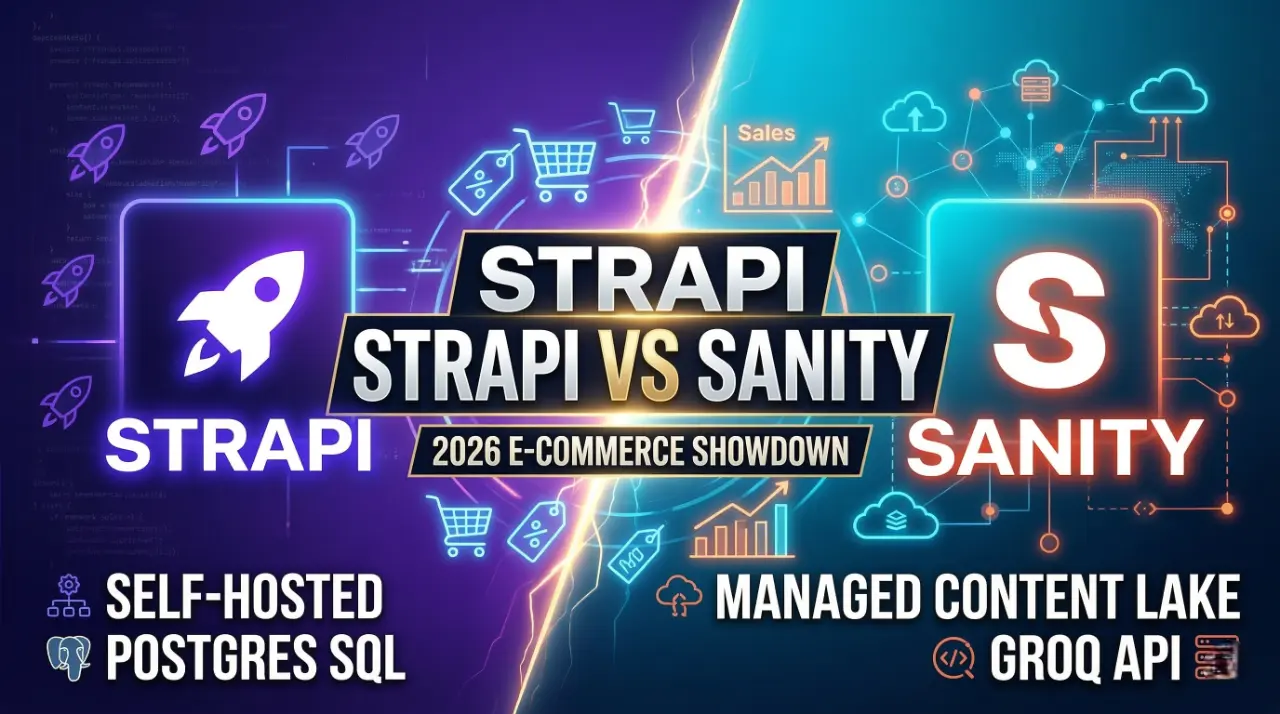
In this guide, we’ll break down the technical comparison of Strapi vs Sanity in 2026, focusing specifically on e-commerce scalability, developer experience, architecture, and infrastructure costs.
The Monolith Bottleneck: Why E-Commerce is Going Headless
Traditional platforms like WooCommerce or Shopify themes follow a monolithic architecture. The backend, frontend, and database are tightly coupled.
That design works fine for:
- Small product catalogs
- Basic storefronts
- Limited customization
But once your store begins to grow, things break down.
Problems With Monolithic E-commerce Platforms
1. Huge Databases Become a Performance Bottleneck
As product catalogs grow, the database becomes extremely complex.
Example scenario:
- 10,000+ products
- 50,000+ variations
- multiple currencies
- multiple regions
Queries start slowing down because everything runs through the same backend layer.
2. Custom Frontend Becomes Difficult
Modern e-commerce stacks now rely on:
- Next.js
- React server components
- Edge rendering
- API-first architecture
Traditional CMS platforms struggle to deliver data efficiently to these systems.
3. Multilingual + Omnichannel Delivery
Large stores now need:
- multiple languages
- region-based pricing
- mobile apps
- marketplaces
- POS systems
A single monolithic backend can’t handle all those channels effectively.
4. Dynamic Pricing Engines
Modern stores often integrate with:
- ERP systems
- inventory systems
- pricing engines
- recommendation engines
With a monolithic CMS, these integrations become fragile and slow.
The Solution: Decoupled Architecture
A headless CMS separates:
| Layer | Responsibility |
|---|---|
| CMS | content & product data |
| Frontend | UI (Next.js / React) |
| APIs | data delivery |
| Services | pricing, inventory |
This architecture allows developers to scale each component independently.
Two popular headless CMS platforms for this architecture are:
- Strapi
- Sanity
Both solve the monolith problem, but their approaches are completely different.
Core Architecture Breakdown: Self-Hosted vs Content Lake
The biggest difference between Strapi and Sanity lies in how data is stored and managed.
Strapi: The Node.js & Relational Database Powerhouse
Strapi is a self-hosted headless CMS built with Node.js.
Developers install and run Strapi on their own infrastructure such as:
- AWS
- DigitalOcean
- Vercel serverless environments
- private cloud servers
Self-Hosted Architecture
A typical Strapi deployment looks like this:
Next.js frontend
      ↓
Strapi API server (Node.js)
      ↓
Relational database
(PostgreSQL / MySQL)
This means you control everything.
Database Layer
Strapi relies on traditional relational databases like:
- PostgreSQL
- MySQL
- SQLite (for development)
This makes it extremely powerful for structured relational data.
Example product schema:
| Entity | Relationship |
|---|---|
| Product | belongs to Category |
| Product | has many Variants |
| Variant | has price |
| Variant | has inventory |
Relational databases handle this type of structure extremely well.
Advantages for E-commerce
Strapi is ideal when your store requires:
- complex product relationships
- advanced filtering
- structured product catalogs
For example:
Category → Product → Variant → PriceThis structure maps perfectly to SQL.
Full Control Over Infrastructure
Because it’s self-hosted, you can control:
- server configuration
- database scaling
- caching layers
- security policies
This is critical for companies with strict data sovereignty requirements.
However, this power comes with responsibility.
Developers must manage:
- deployments
- database backups
- scaling
- uptime
Sanity: The Fully Managed Content Lake
Sanity takes a completely different approach.
Instead of a traditional database, it uses a fully managed content lake.
This system stores data as JSON documents rather than relational tables.
How the Content Lake Works
Sanity stores content like this:
{
  "_type": "product",
  "title": "Running Shoes",
  "price": 120,
  "category": {
    "_ref": "shoes"
  }
}
Each entry is a document inside a globally distributed datastore.
No Server Maintenance
With Sanity:
- You don’t manage servers
- You don’t maintain databases
- You don’t run migrations
Sanity handles:
- scaling
- infrastructure
- CDN delivery
- API availability
This dramatically reduces DevOps workload.
Real-Time Content Infrastructure
Sanity is designed for real-time content updates.
When editors update content:
- changes propagate instantly
- frontends receive updates via APIs
This architecture is similar to Firebase or real-time databases.
Advantages for E-commerce
Sanity works extremely well for:
- Content-heavy storefronts
- Marketing pages
- Omnichannel delivery
For example:
A product page might include:
- Product data
- Reviews
- Editorial content
- Campaign banners
Sanity handles these flexible content structures easily.
Developer Experience (DX) & Next.js Integration
For modern e-commerce stacks, developer experience matters a lot.
Most teams today use:
- Next.js
- React Server Components
- TypeScript
So the question becomes:
Which CMS integrates better with modern React frameworks?
Next.js App Router & TypeScript Support (.tsx)
With the Next.js App Router, applications now use:
- server components
- streaming
- edge rendering
Both Strapi and Sanity support this ecosystem, but in different ways.
Strapi Integration
Strapi exposes data through:
- REST APIs
- GraphQL (via plugin)
Example API call:
GET /api/productsDevelopers then fetch this inside Next.js server components:
const products = await fetch("https://cms/api/products")
Type safety can be achieved through:
- OpenAPI schemas
- GraphQL code generation
However, it often requires manual setup.
Sanity Integration
Sanity offers a more integrated experience.
Developers can generate fully typed queries directly from schemas.
Example:
const products = await client.fetch(groq`*[_type == "product"]`)
Sanity also provides:
- first-party Next.js packages
- real-time preview
- live content updates
This makes Sanity extremely popular in Jamstack environments.
Querying the Data: GraphQL vs GROQ
Data querying is where the biggest technical difference appears.
Strapi Querying Options
Strapi supports:
- REST APIs
- GraphQL plugin
GraphQL example:
query {
  products {
    name
    price
  }
}
GraphQL works well for structured relational queries.
But filtering large catalogs can become complex.
Sanity Query Language: GROQ
Sanity uses its own query language called GROQ.
Example:
*[_type == "product" && price > 100]{
  name,
  price
}
GROQ is extremely powerful for:
- filtering
- projections
- nested data
For large catalogs, it often performs faster because queries run directly against the content lake index.
The Content Editor UI: Managing Products at Scale
Developers aren’t the only users of a CMS.
Content editors, marketers, and product managers interact with it daily.
Strapi Admin Panel: Traditional & Structured
Strapi includes a built-in admin dashboard.
It feels similar to traditional CMS platforms.
Editors manage content through:
- Collection Types → reusable data models
- Single Types → single pages (homepage, settings)
Example product collection:
| Field | Type |
|---|---|
| Name | Text |
| Price | Number |
| Category | Relation |
| Images | Media |
This structured system works well for large product catalogs.
However, customization of the admin UI is somewhat limited.
Sanity Studio: Real-Time Collaboration as a React App
Sanity Studio is fundamentally different.
It’s not just an admin panel — it’s a React application.
Developers can fully customize the editor interface.
Key Advantages
Sanity Studio supports:
- real-time collaboration
- multiple editors simultaneously
- live document updates
It behaves similarly to Google Docs editing.
If two editors modify the same product:
- changes merge automatically
- conflicts are minimized
This is extremely useful for large editorial teams.
E-Commerce Edge Cases: High-Volume SKUs & External APIs
Large stores often manage 10,000+ products.
Handling that scale requires careful architecture.
Common Data Flow
Large e-commerce systems often use:
- ERP systems
- inventory management
- pricing engines
- analytics services
A typical integration flow might look like this:
ERP System
     ↓
Inventory API
     ↓
CMS Sync Layer
     ↓
Headless CMS
     ↓
Next.js Storefront
Strapi Handling Large Catalogs
Strapi performs well when:
- Data is relational
- Product schemas are strict
- Filtering relies on SQL
However, performance depends on database indexing and server scaling.
Sanity Handling Large Catalogs
Sanity performs well when:
- Content structures are flexible
- Product metadata changes frequently
- Omnichannel delivery is required
But some companies still prefer relational databases for complex SKU relationships.
Infrastructure Costs & Scaling
Cost is another major factor.
Strapi Cost Model
Strapi itself is open-source and free.
However, infrastructure costs include:
- cloud servers
- database hosting
- backups
- monitoring
- scaling
Typical stack:
| Component | Example |
|---|---|
| Server | AWS EC2 |
| Database | AWS RDS |
| CDN | Cloudflare |
As traffic grows, DevOps complexity increases.
Sanity Cost Model
Sanity uses usage-based pricing.
Costs depend on:
- API requests
- bandwidth
- stored content
- team members
Benefits include:
- zero infrastructure management
- automatic scaling
- global CDN
For large enterprises, Sanity offers enterprise plans with SLA guarantees.
FAQs
1. Is Strapi better than Sanity for e-commerce?
Strapi is often better for structured product catalogs, while Sanity excels in content-driven commerce experiences.
2. Can Strapi handle large product catalogs?
Yes. With proper database optimization, Strapi can manage tens of thousands of products effectively.
3. Does Sanity support real-time collaboration?
Yes. Sanity Studio allows multiple editors to edit the same content simultaneously.
4. Which CMS works better with Next.js?
Both integrate well with Next.js, but Sanity provides stronger native support and developer tooling.
5. Is Strapi cheaper than Sanity?
Strapi is free, but infrastructure and DevOps costs must be considered.
6. Can both CMS platforms integrate with external APIs?
Yes. Both platforms support integrations with:
- ERP systems
- payment providers
- inventory management
- analytics tools
Final Verdict: Which CMS Fits Your Tech Stack?
Choosing between Strapi and Sanity ultimately depends on your technical priorities.
Choose Strapi if you need:
- full control over infrastructure
- relational database architecture
- strong SQL-based product relationships
- data privacy and self-hosting
Choose Sanity if you want:
- zero server maintenance
- real-time collaborative editing
- flexible content models
- powerful GROQ queries
In simple terms:
| Use Case | Best CMS |
|---|---|
| Developer-controlled infrastructure | Strapi |
| Content-driven commerce | Sanity |
| SQL-based product catalogs | Strapi |
| Real-time collaborative editing | Sanity |
For many modern Next.js-based e-commerce stacks, Sanity offers faster development and fewer infrastructure headaches.
But for companies that require complete backend control and relational data modeling, Strapi remains an incredibly powerful option.