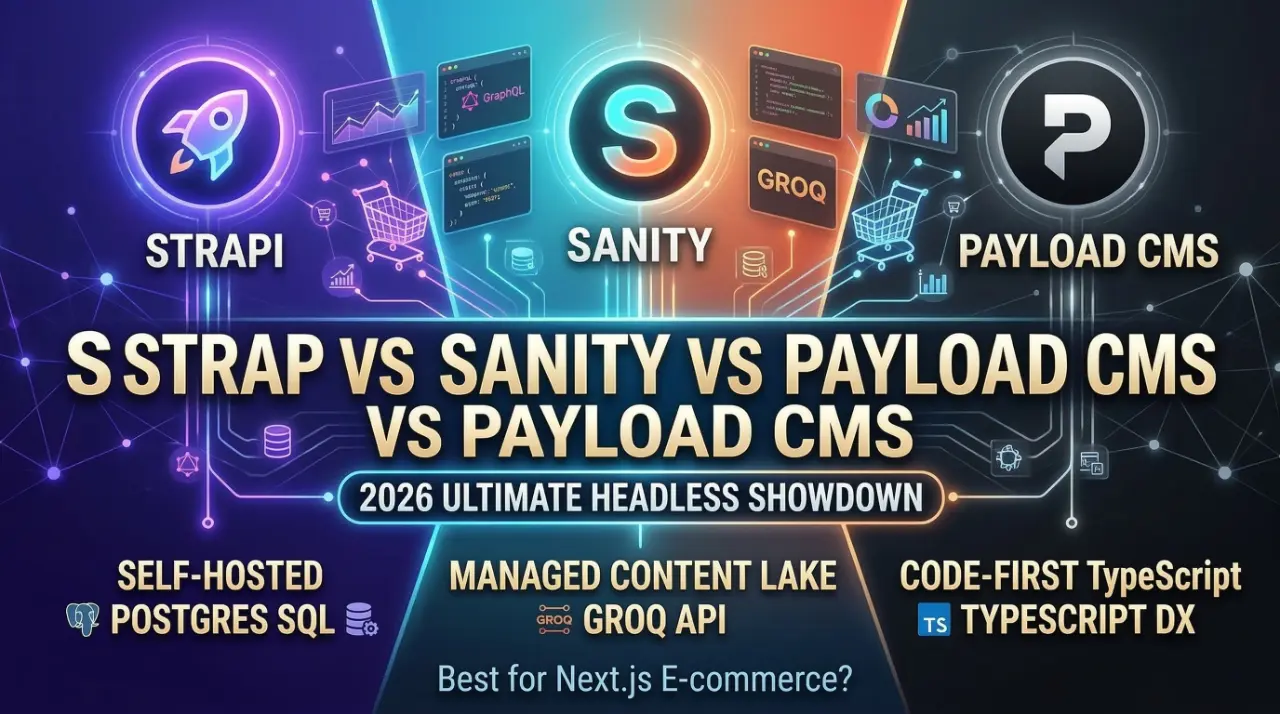
The headless CMS ecosystem in 2026 has matured significantly. Modern web applications, especially Next.js commerce platforms, require CMS solutions that are flexible, scalable, and developer-friendly. Three platforms dominate developer conversations today: Strapi, Sanity, and Payload CMS.
Each platform approaches headless architecture differently. Some prioritize developer control, others focus on content collaboration, and some aim for type-safe application frameworks.
Why Headless CMS Matters in 2026
Traditional CMS platforms were designed for websites only. Modern commerce systems must support web storefronts, mobile apps, POS systems, marketplaces, IoT devices, and marketing automation tools. Because of this, many companies adopt a headless architecture.
Typical Headless Stack
| Layer | Technology |
| Frontend | Next.js / React |
| CMS | Strapi / Sanity / Payload |
| Database | PostgreSQL / Content Lake |
| API Layer | REST / GraphQL |
| Infrastructure | Vercel / AWS |
The CMS now functions as a data layer instead of a website builder. This shift makes developer experience, API performance, and data modeling extremely important.
Architecture Comparison: Three Different Philosophies
The biggest difference between these platforms is how they manage data and infrastructure. Each philosophy suits a different engineering culture.
| Platform | Architecture Type |
| Strapi | Self-hosted CMS with relational DB |
| Sanity | Fully managed Content Lake |
| Payload CMS | Code-first Node.js CMS |
1. Strapi: The Open-Source Relational CMS
Strapi is one of the most popular open-source headless CMS platforms. It is built with Node.js, REST APIs, optional GraphQL, and relational databases.
Infrastructure Model
Developers host Strapi themselves on AWS, DigitalOcean, Vercel, or private servers.
- Typical architecture: Next.js frontend → Strapi API → PostgreSQL/MySQL.
Strengths of Strapi
- Full Infrastructure Control: Companies can manage servers, security, database configuration, and caching. This is essential for regulated industries or enterprise environments.
- Strong Relational Data Modeling: E-commerce products often require complex relationships (e.g., Product Category, Product Variants, Variant Inventory, Variant Pricing). SQL databases handle these structures very efficiently.
- Mature Plugin Ecosystem: Strapi supports plugins for authentication, GraphQL, uploads, and custom APIs.
Weaknesses
- Strapi requires DevOps knowledge. Teams must manage server uptime, scaling, database migrations, and backups. For startups without infrastructure teams, this can be heavy.
2. Sanity: The Real-Time Content Lake
Sanity takes a radically different approach. Instead of relational tables, it uses a globally distributed content lake where all data is stored as JSON documents.
JSON
{
  "_type": "product",
  "title": "Running Shoes",
  "price": 120
}
Fully Managed Infrastructure
Sanity handles servers, database scaling, CDN delivery, and API uptime. Developers interact with Sanity through APIs only.
Strengths of Sanity
- Real-Time Collaboration: Sanity Studio supports multiple editors, live document updates, and Google Docs-style editing. This is extremely useful for large marketing teams.
- Powerful Query Language (GROQ): Sanity uses GROQ, a flexible query language designed for document data that is highly efficient for content filtering and projections.Code snippet
*[_type == "product" && price > 100]{ title, price } - Best-in-Class Next.js Integration: Sanity provides official Next.js libraries, live preview, edge caching, and typed queries. Many Jamstack teams consider Sanity the best CMS for Next.js.
Weaknesses
- Sanity has a usage-based pricing model. Costs increase with API requests, bandwidth, and team size. For extremely large stores, this can become expensive.
3. Payload CMS: The Code-First Developer CMS
Payload CMS is a newer, but rapidly growing headless CMS that focuses heavily on developer experience and type safety. Payload is built with Node.js, TypeScript, MongoDB or PostgreSQL, and GraphQL and REST APIs. The biggest difference is its code-first approach.
Code-First Schema Design
Instead of defining content models in a GUI, developers define them directly in code.
export const Products = {
  slug: "products",
  fields: [
    { name: "title", type: "text" },
    { name: "price", type: "number" }
  ]
}
(Note: The syntax typo from the original document has been corrected).
Advantages
- Full Type Safety: Payload generates types automatically, providing full TypeScript support. This ensures safer queries, better IDE support, and fewer runtime bugs.
- Deep Customization: Because schemas are defined in code, developers can build extremely custom logic.
- First-Class Next.js Integration: Payload integrates tightly with modern React stacks. Many developers use Payload as both CMS and backend framework.
Weaknesses
- Payload is newer than Strapi and Sanity. This means a smaller ecosystem, fewer community plugins, and less enterprise adoption. However, its growth rate is extremely fast.
Developer Experience (DX) Comparison
Developer experience is critical when building modern commerce systems. Here is a comparison of how these platforms feel to work with.
| Feature | Strapi | Sanity | Payload |
| TypeScript Support | Medium | Strong | Excellent |
| Schema Flexibility | Good | Very flexible | Code-level control |
| Learning Curve | Easy | Medium | Medium |
| DevOps Required | Yes | No | Yes |
- Strapi: Traditional CMS development experience.
- Sanity: API-first content platform.
- Payload: Developer-centric application framework.
Technical Deep-Dives
Querying Data: REST vs GraphQL vs GROQ
- Strapi: Supports REST and a GraphQL plugin. (e.g.,
GET /api/products) . - Sanity: Uses GROQ, which allows complex filtering and projections in a single query. (e.g.,
*[_type == "product"]) . - Payload: Supports both REST and GraphQL. Developers often use GraphQL because Payload schemas map directly to GraphQL types.
Content Editing Experience
- Strapi Admin Panel: Provides a traditional CMS dashboard familiar to users coming from WordPress or Drupal. Editors manage collection types, single types, and a media library.
- Sanity Studio: A React-based editor that allows real-time collaboration, customizable interfaces, and live previews. Editors can work simultaneously without conflicts.
- Payload Admin UI: Provides a minimal but flexible admin interface that developers can customize heavily. It currently lacks the real-time collaboration features found in Sanity.
Handling Large E-commerce Catalogs
Large stores often have 10,000+ products, 100,000+ variants, and multi-region pricing, requiring strong data modeling.
- Strapi: Best for structured product data because relational databases handle complex product relationships very well.
- Sanity: Better suited for content-driven commerce where marketing content is as important as product data.
- Payload: Excellent for custom commerce architectures where developers want to build deeply integrated systems.
Infrastructure Costs
- Strapi: Software is free, but infrastructure costs include servers, database hosting, monitoring, and backups.
- Sanity: Usage-based pricing (API calls, bandwidth, storage, team members). It removes the need for DevOps but may scale in cost.
- Payload: Self-hosted like Strapi. Costs depend on server hosting, database hosting, and scaling requirements.
Quick Comparison Summary
| Feature | Strapi | Sanity | Payload |
| Hosting | Self-hosted | Fully managed | Self-hosted |
| Database | SQL | Content Lake | MongoDB / Postgres |
| Real-time Editing | No | Yes | No |
FAQs
Which CMS is best for Next.js?
Sanity and Payload both integrate extremely well with Next.js, though Sanity currently has the strongest ecosystem.
Is Payload CMS better than Strapi?
Payload offers better type safety and code-first development, but Strapi has a larger ecosystem.
Can Sanity handle e-commerce catalogs?
Yes, especially when paired with commerce platforms like Shopify or custom APIs.
Is Strapi still popular in 2026?
Yes. It remains one of the most widely used open-source headless CMS platforms.
Which CMS is easiest to maintain?
Sanity is easiest because infrastructure and scaling are fully managed.
Which CMS offers the most developer control?
Payload and Strapi both offer full backend control, but Payload provides the most code-level customization.
Final Verdict: Which CMS Should You Choose?
Choosing between Strapi vs Sanity vs Payload CMS depends on your engineering priorities.
- Choose Strapi if you want an open-source CMS, relational database architecture, and full infrastructure control.
- Choose Sanity if you want real-time collaborative editing, zero DevOps maintenance, and powerful content querying.
- Choose Payload CMS if you want code-first development, full TypeScript support, and deep backend customization.
| Use Case | Best CMS |
| Enterprise self-hosted infrastructure | Strapi |
| Content-driven commerce | Sanity |
| Developer-centric architecture | Payload |